
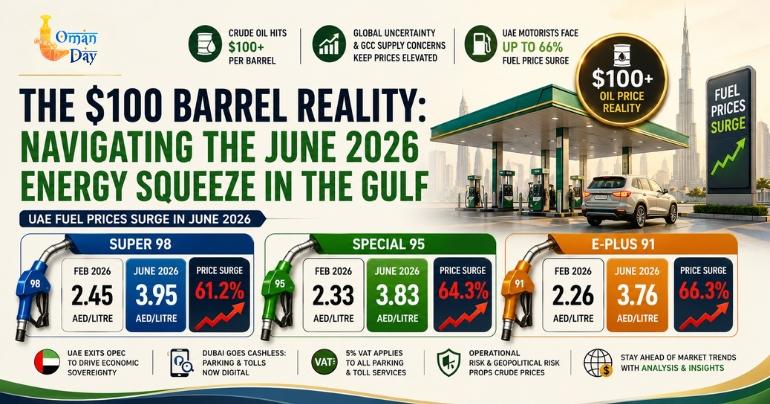
The $100 Barrel Reality: Navigating the June 2026 Energy Squeeze in the Gulf
The Price of a New Normal
The Gulf region faces a fascinating economic paradox this June. Global headlines buzz with cautious optimism about Middle East peace negotiations. However, local residents face a much harsher financial reality at the gas pump.
Diplomats in Washington discuss frameworks for long-term regional stability currently. Meanwhile, the daily cost of living continues its relentless, frustrating climb. This gap between peace rumors and rising commutes reveals a structural shift.
The regional economic engine is finally decoupling from political rhetoric. Residents must look past the peace rumors to navigate this new June reality.
The 66% Sticker Shock in the UAE
UAE motorists face an upward fuel price revision for the fourth consecutive month. A small monthly increase has snowballed into a staggering 66 percent surge.
This massive price surge began back in February 2026. Super 98 petrol cost a very modest 2.45 dirhams per litre back then. Today tells a completely different financial story for daily commuters.
| Fuel Type | Feb 2026 (AED/Litre) | June 2026 (AED/Litre) | Increase (%) |
|---|---|---|---|
| Super 98 | 2.45 | 3.95 | 61.2% |
| Special 95 | 2.33 | 3.83 | 64.3% |
| E-Plus 91 | 2.26 | 3.76 | 66.3% |
This pain extends far beyond the UAE borders today. QatarEnergy raised Premium 91 petrol to 2.00 riyals for June. However, Oman capped retail gasoline at 0.62 US dollars per litre.
This strict cap effectively shields Omani consumers from global price spikes. Diesel provides the only tiny silver lining in the UAE right now. The diesel price dropped to 4.33 dirhams per litre this June.
Consumers will pay 33 dirhams more for a full 120-litre tank this month.
The UAE Leaves OPEC for Stability
The UAE recently executed a very audacious strategic economic move. Leaders officially exited the powerful OPEC alliance to secure independent economic sovereignty. The collective alliance often prioritized global production quotas over national vision.
The UAE now possesses the absolute freedom to manage its own energy output. Experts anticipate this massive move will stabilize domestic fuel prices eventually. The UAE can bypass production caps and flood the market if necessary.
However, consumers remain fully exposed to current global pricing volatility right now. The UAE desires an independent, high-tech, post-oil future today.
The Resilience of Iranian Ghost Bases
Perceived supply chain fragility drives the heavy conflict premium on oil prices. However, recent satellite imagery reveals a very surprising military reality. Military strikes do not permanently neutralize Iranian defense infrastructure.
Iran successfully reopened 50 tunnel entrances at 18 underground facilities recently. They achieved this massive rebuild just seven weeks after US-Israeli strikes. Tehran uses dump trucks to restore its Ghost Bases incredibly fast.
This persistent infrastructure keeps crude oil prices stubbornly high. High-tech weaponry cannot easily neutralize these embedded geopolitical risks today.
Dubai Transitions to Cashless Parking
Dubai continues to iterate its Smart City engine amidst regional turmoil. June 1 marks the absolute end of the humble parking coin. The city transitions entirely to a 100 percent cashless digital parking system.
This shift simplifies the urban experience but includes a fiscal catch. A 5 percent VAT now applies to all daily parking services. This new tax even affects seasonal parking permits for residents.
Motorists must also pay higher Salik toll fees now. Peak-hour crossings cost 6.30 dirhams, up from the previous 6 dirhams. Salik tag activation fees also rose to 52.50 dirhams recently.
New Digital Payment Channels for Parking:
- Parkin App & RTA App
- nol cards
- SMS parking service
- Dubai Now app
The In-Between Oil Market
We are currently navigating a tricky in-between phase in energy markets. U.S. Energy Secretary Chris Wright stated gasoline prices have likely peaked. However, the hard data tells a much more complex economic story.
Peace rumors momentarily dropped Brent crude to 91 dollars per barrel. Yet, the reality is that prices averaged 106 dollars in May. This 15 dollar gap explains the lack of local pump relief.
The market must stabilize consistently below the triple-digit mark first. Until then, political optimism remains at odds with your bank balance.
Saudi Arabia Struggles With Export Pricing
Saudi Arabia set its official June crude oil prices recently. Saudi Aramco implemented a 4.00 dollar per barrel reduction for East Asian buyers. This cut responded to a record-high premium charged in May.
That massive May premium compressed Chinese refining margins severely. It caused Saudi crude exports to China to plummet by 76 percent. Asian refiners aggressively secured cheaper spot alternatives like Russian ESPO instead.
This pricing crisis forced the Kingdom into a significant fiscal deficit.
The Quick Peace Scenario
Wood Mackenzie developed an interesting Quick Peace oil market projection. This scenario models a diplomatic breakthrough resolving the US-Israel-Iran conflict. It assumes the vital Strait of Hormuz reopens by June 2026.
Brent crude prices would drop sharply to 80 dollars per barrel initially. Prices would decline further to 65 dollars in 2027. However, necessary naval clearance operations will significantly delay commercial shipping recovery.
This scenario represents a massive direct threat to Saudi Arabia. A Quick Peace combines severe revenue loss with massive war expenditures.
Navigating the Summer Heat
The regional landscape is fundamentally restructuring heading into summer 2026. The UAE pursues energy independence while Dubai transitions into a cashless hub. The daily cost of doing business in the Gulf is changing.
Is this $100-plus barrel reality a temporary spike or a permanent shift? The region must balance its ambitious future against an expensive new normal.
Want to stay ahead of the volatile global energy curve? Explore more financial breakdowns and market trends on the Oman Day homepage!
tag: gulf-fuel-prices , uae-petrol-cost , oman-oil-price , brent-crude , opec-exit , dubai-parking , middle-east-economy , oman-day
Share This Post