
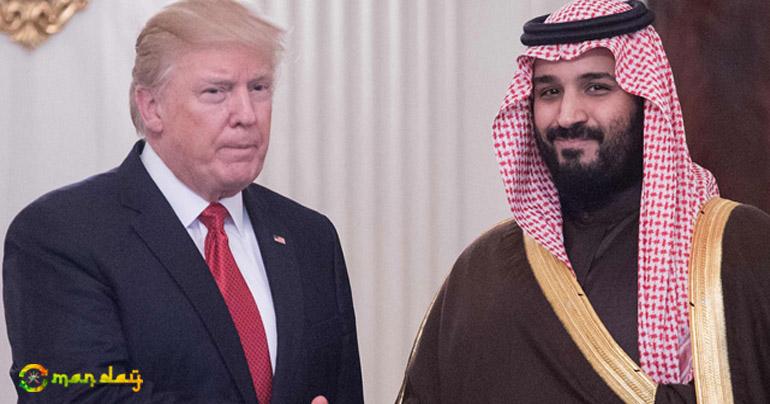
Trump Is Betting Everything In The Middle East On The Saudi Crown Prince
Donald J. Trump is not abiding by a central tenet of international diplomacy -- choose your friends wisely, particularly in the Middle East.
For decades, American leaders have steered carefully between the Scylla and Charybdis of ancestral enemies -- Saudi Arabia and Iran -- in hopes of maintaining some vestige of peace, or at least the absence of outright war, in the region.
And yet now, as the two nations find themselves locked in a direct battle for total dominance in the Middle East, the US is choosing to favor Saudi Arabia. This choice makes America a clearer target of Iran and presents an even more imminent danger since it's unlikely any compromise might be negotiated that could reduce the threat of an armed conflict.
In Yemen, Saudi and Iranian proxies have chosen sides in a war that places the population of 28 million at risk of famine or death by military attacks.
In Qatar, the effort of the one Arab nation that has sought to maintain an even tenuous balance between the two nations, is seen by the rulers of Saudi Arabia as a full-throated embrace of Iran and all it represents. The result has been a monthslong blockade and outright ostracism in an effort to bludgeon Qatar into submission to the Saudis' will.
And, most recently, the Saudis have sought to extend their reach into Lebanon, one of the last truly stable democracies in the entire region. This tiny nation of 6 million, strategically balanced between Israel and Syria, suddenly finds itself drawn deeply into an Iranian-Saudi conflict it has tried in vain to avoid. Its beloved Prime Minister, Saad Hariri, when he landed in Riyadh, was forced to read on live television a speech announcing his resignation.
After escaping the Saudis' clutches, Hariri returned to Beirut and triumphantly rescinded his resignation. And the Middle East has been plunged even deeper into some form of instability since then.
Iran, lining up ever more resolutely with forces calculated to cement its own dominance from Baghdad to Beirut and beyond, is becoming a force to be reckoned with across the region and far beyond. Indeed, the Iranian navy's commander, Rear Adm. Hossein Khanzadi told the nation's Tasnim News Agency that a fleet of Iranian warships "in the near future will visit one of the friendly states in South America and the Gulf of Mexico," possibly Venezuela, whose relations with the United States have deteriorated as they have risen with Iran. Quite a signal to the Trump administration.
At the same time, however, the Saudis are still acting from what they believe is an unprecedented position of strength. And that position is only reinforced by Trump.
From his first stop abroad as President last May, Trump seems to have thrown all caution to the wind by aligning with Saudi Arabia in this thoroughly toxic environment. Then, the President's son-in-law, Jared Kushner, charged with bringing peace to the Middle East, flew suddenly and unannounced to Riyadh last month to dine and converse late into the night with the powerful 32-year-old Crown Prince Mohammed bin Salman. Days later, MBS, as he is known, shockingly ordered the arrest of 11 princes and scores of business leaders for "corruption" -- a power play that seems to have gone unchallenged, either in Riyadh or Washington. Could MBS have gotten a tacit buy-in from Trump's 36-year-old princeling, particularly since the two fathers -- Trump and King Salman -- talked by phone just hours after the mass arrests?
Regardless, the Trump administration is making a dangerous move. The kingdom will soon be ruled by a young, untested and clearly impulsive heir apparent. His interests seem to oscillate between himself, his immediate family and a broader agenda that could prove quite dangerous to such a volatile region.
...[ Continue to next page ]
tag: blog , information
Share This Post